
Industrial-Grade PTO Shaft for Peanut Harvester Equipment
When groundnut lifting and collection is your business, downtime is not an option. Our industrial-grade PTO shaft for peanut harvester is manufactured from high-strength alloy steel with induction-hardened splines and needle-bearing universal joints. Designed for the rigorous duty cycles of commercial farming, this shaft maintains peak torque delivery while protecting both tractor and implement from shock loads.
Technical Specifications – Peanut Harvester PTO Shaft
| Parameter | Spezifikation / Anpassbarer Bereich |
|---|---|
| Anwendung | Peanut Harvester |
| Empfohlene Traktorleistung | 60–180 PS |
| Zapfwellendrehzahl | 540 rpm |
| Maximales Dauerdrehmoment | 400–1200 Nm |
| Maximales Drehmoment | 1800 Nm |
| Schaftserie | T4 / L4 (Mittelschwere bis schwere Beanspruchung) / T5 / L5 (Schwere Beanspruchung) / T6 / L6 (Extrem schwere Beanspruchung) |
| Yoke Material | Forged carbon steel (C45) |
| Dynamisches Gleichgewicht | Factory balanced |
| Maximum Extended Length | 1674 mm |
| Maximaler Betriebswinkel | 80° |
| Keilwellenhärte | HRC 55-60 |
| Betriebstemperaturbereich | -30°C to +100°C |
| Surface Treatment | Yellow zinc plated |
| Kreuzgelenkgröße | 23.8×61.3 mm / 22×54.8 mm / 27×70 mm |
| Optionen für die Jochaufnahme am Traktorende | Keilwellengabel (1-3/8″ 21-Zahn) / Keilwellengabel (1-3/8″ 6-Zahn) |
| Gardefarbe | Orange (RAL 2004) |
| Geschlossene Länge (Lmin) | 800–1300 mm (anpassbar) |
| Empfohlenes Schmiermittel | EP2 lithium-complex |
| Überlastschutzoptionen | Free-wheel overrunning clutch / Shear bolt torque limiter / Ratchet torque limiter |
| Rohrprofil | Square profile or Triangular profile |
PTO Shaft Structure & Function on the Peanut Harvester
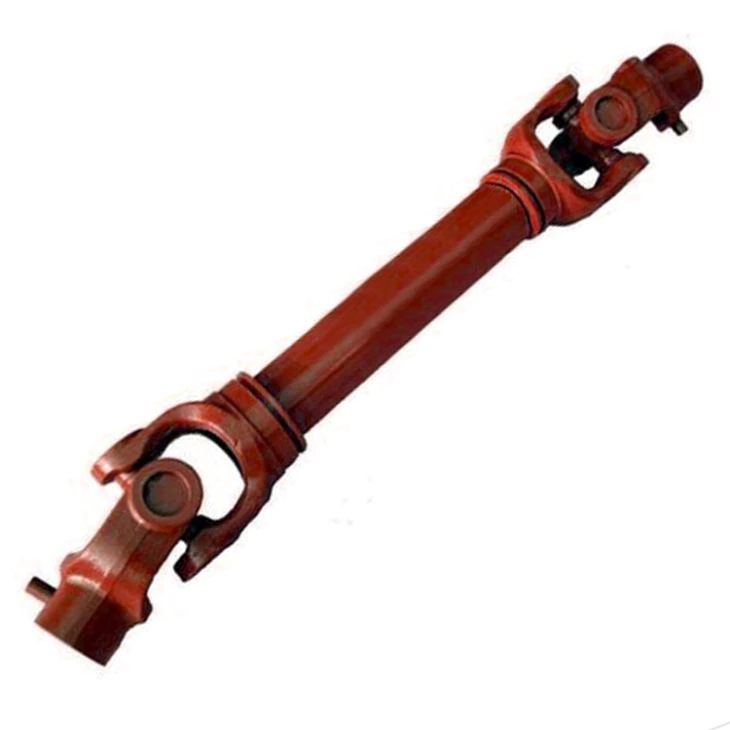
The power take-off (PTO) shaft is positioned between the rear of the tractor and the front input of the peanut harvester. It is a two-piece telescoping assembly connected by universal joints at each end. The tractor-end yoke mates with the PTO stub shaft, while the implement-end yoke connects to the peanut harvester’s gearbox input.
When engaged, rotational power flows from the tractor’s engine through the PTO gearbox, out the stub, through the first U-joint, along the profile tube, through the second U-joint, and into the implement. During groundnut lifting and collection, this power drives the cutting, turning, or processing mechanism of the peanut harvester.
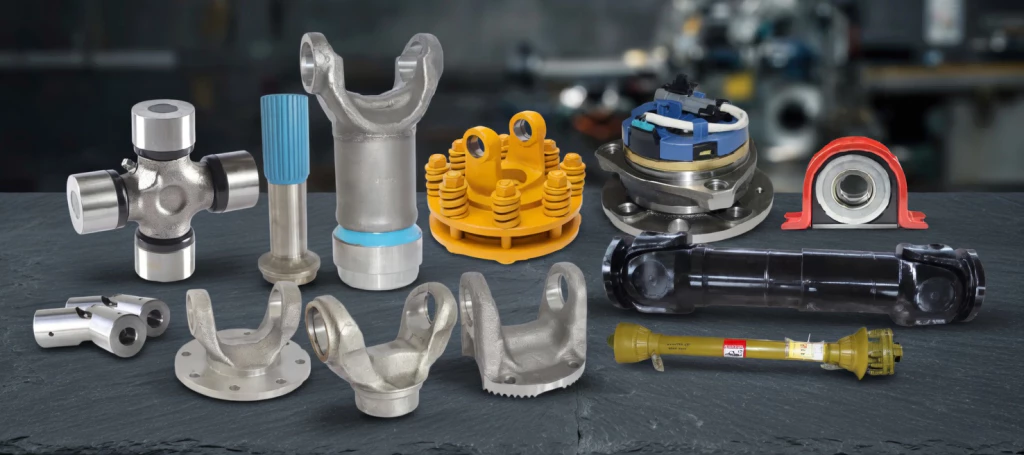
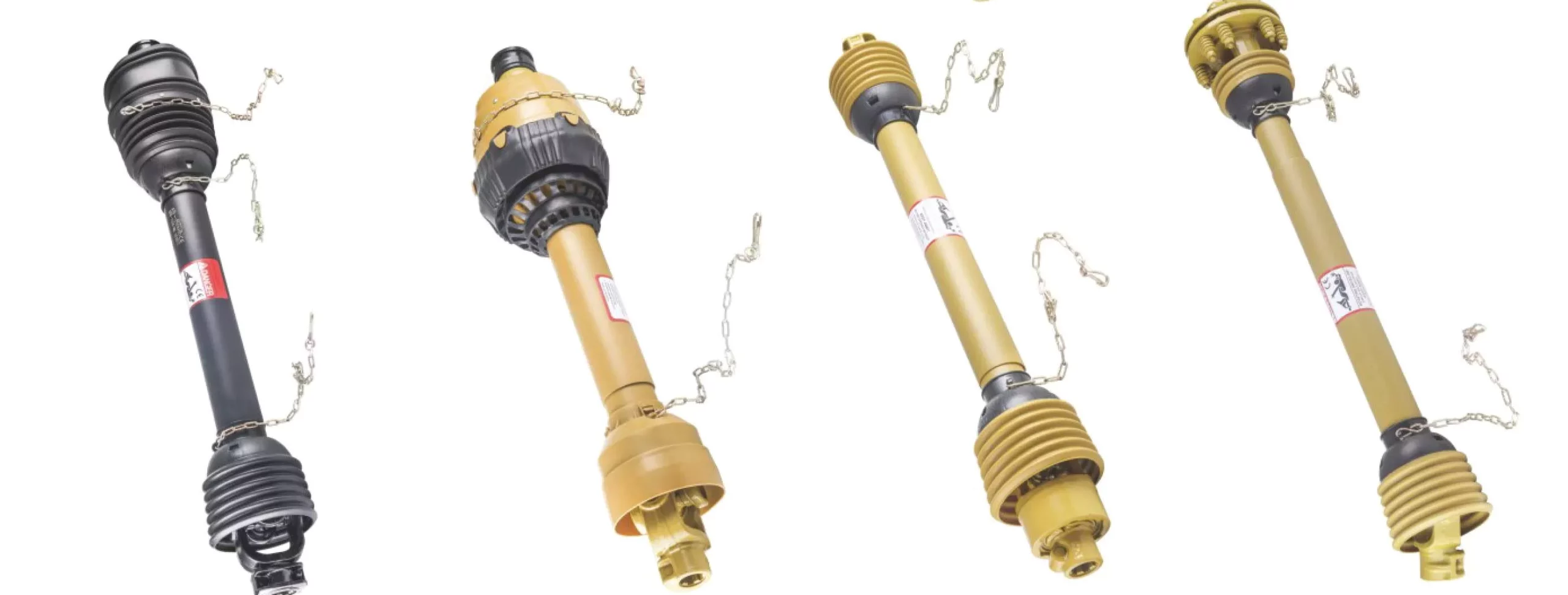
Key structural components include: hardened splined yokes for positive engagement, needle-bearing U-joint crosses for smooth rotation under load, telescoping tubes for length adjustment, plastic safety shields with bearing-supported rotation, and an overload clutch or shear pin to protect the entire driveline from catastrophic failure.
Core Advantages of Our PTO Shaft for Peanut Harvester
⚙ Forged Yoke Technology
Unlike stamped alternatives, our forged yokes for the peanut harvester PTO shaft deliver superior grain structure and impact resistance for demanding applications.
🔧 Wide-Angle Joint Option
Wide-angle constant-velocity joints available for applications requiring operating angles up to 80°, ideal for tight turning radii and steep terrain.
🔒 Automatic Re-engagement
Friction clutch models automatically re-engage once the overload condition clears, minimising downtime and getting you back to work faster.
⚖ Anti-Corrosion Finish
Zinc-plated hardware and powder-coated guards resist corrosion from agricultural chemicals, moisture, and UV exposure.
🛠 Metric & Imperial Compatibility
Dual-standard spline options ensure compatibility with both metric and imperial PTO stubs across all major tractor brands.
🏆 Global Quality Certification
ISO 9001:2015 certified manufacturing with full material traceability from raw steel to finished product.
Brand Compatibility & Replacement Parts
Our PTO shaft for peanut harvester is designed as a direct-fit replacement for driveline assemblies supplied by GKN Walterscheid, MecLine, Bondioli & Pavesi, Profile Connect, Driveline Parts, Walterscheid, and others. We stock cross-reference guides to help you identify the correct shaft for your existing equipment.
⚠ Brand names are referenced solely for cross-compatibility identification purposes. We are not affiliated with, nor do we claim endorsement by, any of the brands mentioned. All trademarks remain the property of their respective owners.
Spare Parts & Accessories
Every component of our PTO shaft is available individually: U-joint cross kits, yokes (tractor-end and implement-end), profile tubes, safety guards, guard chains, torque limiters, and bearing kits. This means you can service and rebuild your shaft indefinitely, reducing long-term ownership costs.
Regulations, Compliance & Local SEO Considerations
Australian Safety Standards
All PTO shafts supplied for peanut harvester applications comply with AS 1121 (Power take-offs for agricultural tractors) and AS/NZS 4024.1 (Safety of machinery). Safety guards meet the guarding requirements of Safe Work Australia’s model WHS Regulations.
CE & ISO Compliance
Our manufacturing facility holds ISO 9001:2015 certification. Shaft assemblies are designed in accordance with ISO 5673 (Agricultural tractors and machinery – PTO drive shafts) and CE-marked where applicable.
State & Territory Requirements
PTO-driven equipment across Queensland, New South Wales, Victoria, Western Australia, South Australia, and Tasmania must comply with local WHS codes of practice for agricultural machinery. Our shafts are supplied with all required safety guarding and documentation to meet these obligations.

PTO Shaft Selection Guide – Peanut Harvester
Selecting the right PTO shaft for your peanut harvester is straightforward when you follow this step-by-step guide. Gather the information below before placing your order.
| Step | Action | Details for Peanut Harvester |
|---|---|---|
| 1 | Identify tractor PTO HP | Typical: 60–180 HP for this application |
| 2 | Confirm PTO speed setting | 540 rpm or 1000 rpm (check implement manual) |
| 3 | Measure closed length (Lmin) | 800–1300 mm |
| 4 | Count tractor PTO splines | 6-spline (1-3/8") or 6-spline (1-3/4") most common |
| 5 | Check implement input connection | Splined, keyed, or flanged input |
| 6 | Calculate torque requirement | 400–1200 Nm |
| 7 | Select shaft series | T4 / L4 (Medium-heavy duty) or T5 / L5 (Heavy duty) |
| 8 | Choose overload protection | Friction clutch recommended for peanut harvester |
📌 Need help? Kontaktieren Sie uns for expert guidance.
Targeted Installation Procedure – Peanut Harvester PTO Shaft
⚠ Safety First: Disengage the PTO, switch off the engine, remove the ignition key, and allow all moving parts to come to a complete stop before working on the driveline. Wear appropriate PPE including close-fitting clothing and gloves.
Phase 1: Preparation
Lay out all shaft components and cross-reference against the packing list. Confirm the shaft series, closed length, and yoke specifications match your peanut harvester setup. Grease all U-joint nipples and slide the profile tubes back and forth several times to distribute lubricant.
Phase 2: Length Verification
With the peanut harvester hitched to the tractor in its normal operating position, measure the PTO-to-input distance. The shaft must have a minimum of 1/3 tube overlap at full extension and must not bottom out at the shortest position. Trim the tubes if the factory length requires adjustment (refer to cutting instructions in the product manual).
Phase 3: Tractor Connection
Push the tractor-end yoke fully onto the PTO stub. The quick-release collar should snap over the retaining groove. Pull back on the yoke to confirm it is locked. If using a plain-bore yoke, insert the shear pin and secure with a cotter pin.
Phase 4: Implement Connection
Connect the implement-end yoke to the peanut harvester’s input. If a clutch assembly is fitted at this end, ensure the clutch housing is oriented with the grease nipple accessible. Tighten any set screws to the specified torque.
Phase 5: Guard Fitting
Assemble the two guard halves around the shaft and clip together. Attach the anti-rotation chains: one chain to a stationary tractor point, one chain to the implement frame. Verify the guards spin freely by hand without contacting any part of the shaft or yokes.
Phase 6: Operational Test
Start the tractor, engage PTO at low idle, and run the peanut harvester unloaded for two to three minutes. Check for vibration, abnormal noise, or heat at the U-joints. If all checks pass, proceed to normal operating speed and begin field work. Re-torque all fasteners after the initial run-in period.
PTO Shaft Troubleshooting Guide for Peanut Harvester
⚠ Overload clutch slipping under normal load
Possible Cause: Kupplungsscheiben verschlissen oder verschmutzt; falsches Drehmoment eingestellt
Recommended Action: Drehmomenteinstellung der Kupplung anpassen; Kupplungsscheiben bei Verschleiß oder Ölverschmutzung ersetzen
⚠ Safety guard not rotating freely
Possible Cause: Schutzlager blockiert; Schutzvorrichtung beschädigt oder falsch ausgerichtet
Recommended Action: Schutzlager austauschen; Schutzhälften richten oder ersetzen; Ketten wieder korrekt befestigen.
⚠ Implement speed inconsistent
Possible Cause: PTO shaft slipping; worn splines; clutch partially engaged
Recommended Action: Check yoke engagement; replace yoke if splines are worn; adjust or replace clutch assembly
⚠ Heat build-up at U-joint
Possible Cause: Unzureichende Schmierung; zu großer Betriebswinkel; Lagerausfall
Recommended Action: Kreuzgelenke sofort fetten; Betriebswinkel verringern; Kreuzgelenksatz bei beschädigten Lagern austauschen.
⚠ Clicking or knocking noise at low speed
Possible Cause: Verschleißte Nadellager der Kreuzgelenke; lockere Gabel am Zapfwellenstummel
Recommended Action: Kreuzgelenk austauschen; Verzahnungsverschleiß und Jochverriegelungsmechanismus prüfen.
⚠ Excessive vibration during operation
Possible Cause: Verschleiß der Kreuzgelenklager; Unwucht der Welle; zu großer Betriebswinkel
Recommended Action: Kreuzgelenksatz ersetzen; Jochausrichtung prüfen; Betriebswinkel auf <25° reduzieren
⚠ PTO shaft disconnects during operation
Possible Cause: Verschlissener Sicherungsring; beschädigte Haltenut am Zapfwellenstummel
Recommended Action: Schnellkupplungsgabel ersetzen; Zapfwellenstummelnut prüfen und gegebenenfalls reparieren, falls verschlissen
⚠ Unusual whining or grinding sound
Possible Cause: Ausfall des Getriebeeingangslagers; falsch ausgerichtete Welle
Recommended Action: Getriebe des Anbaugeräts prüfen; Traktor und Anbaugerät neu ausrichten; Wellenlängenüberlappung prüfen.
Case Studies – PTO Shaft for Peanut Harvester in Australia
Feldnotizen unseres Ingenieur- und Vertriebsteams in ganz Australien:
📍 Albany, WA – Glen Armstrong
Zweck: Upgraded overload protection from shear bolt to friction clutch for smoother groundnut lifting and collection
Rückmeldung: “Fitted perfectly to my peanut harvester with zero modification. The quality is noticeably better than the OEM shaft it replaced. I’ll be ordering more for my other implements.”
📍 Esperance, WA – Darren Hughes
Zweck: Purchased a complete PTO shaft assembly as a spare for the busy season
Rückmeldung: “I ordered a replacement cross kit six months later and it arrived within 48 hours. Great product, great service, great support.”
📍 Merredin, WA – James Mitchell
Zweck: Replaced a worn PTO shaft on a 3-year-old peanut harvester to restore full operating efficiency
Rückmeldung: „Schnelle Lieferung in ländliche Gebiete Australiens. Die Welle kam gut verpackt an und die Kreuzgelenke laufen butterweich. Ich bin von der Verarbeitungsqualität sehr beeindruckt.“
📍 Toowoomba, QLD – Michael Carter
Zweck: Upgraded from a light-duty shaft to a heavy-duty series for commercial-scale groundnut lifting and collection
Rückmeldung: “We run our peanut harvester hard across 2,000 hectares and this shaft hasn’t missed a beat after two full seasons. Exceptional value for money.”
📍 Dubbo, NSW – Tony Blake
Zweck: Nachdem die Originalwelle mitten in der Saison einen Defekt am Kreuzgelenk erlitten hatte, wurde ein passgenauer Ersatz benötigt.
Rückmeldung: “The integrated friction clutch saved my gearbox when we hit a buried rock. The shaft disengaged instantly and re-engaged once the obstruction was cleared. Worth every cent.”
Frequently Asked Questions – PTO Shaft for Peanut Harvester
❓ Do you ship to regional and remote Australia?
Absolutely. We ship to all Australian postcodes via major freight carriers. Regional and remote areas may have slightly longer transit times, but we work with multiple carriers to ensure reliable delivery across the country.
❓ Can the shaft be shortened to fit my setup?
Yes. The telescoping profile tubes can be cut to a shorter length using an angle grinder or chop saw. Ensure a minimum of 1/3 overlap remains between the inner and outer tubes after cutting. Deburr all cut edges before reassembly.
❓ Will this shaft fit my tractor and peanut harvester?
Our PTO shafts are available with all standard yoke types and spline sizes (1-3/8" 6-spline, 1-3/4" 6-spline, 1-3/4" 20-spline, and more). Provide your tractor model and peanut harvester make/model, and our team will confirm compatibility before dispatch.
❓ How do I measure the correct closed length?
Hitch the implement to the tractor in its normal working position. Measure the straight-line distance from the face of the tractor PTO stub to the face of the implement input shaft. The shaft closed length should be approximately 10–15 mm less than this measurement.
❓ Welche Garantie bieten Sie auf Zapfwellen an?
Alle Zapfwellen verfügen über eine Herstellergarantie gegen Material- und Verarbeitungsfehler. Die Garantiebedingungen variieren je nach Serie. Kontaktieren Sie unser Team für spezifische Garantieinformationen zu Ihrem Produkt.
❓ What PTO shaft series do I need for my peanut harvester?
For most peanut harvester applications in the 60–180 HP range, we recommend the T4 / L4 (Medium-heavy duty) or T5 / L5 (Heavy duty) series. If you operate near the upper end of this range or in particularly demanding conditions, consider stepping up to the S8 (Wide-angle) series for additional safety margin.
❓ Wie oft sollte ich die Zapfwelle abschmieren?
Fetten Sie alle Kreuzgelenknippel alle 8–10 Betriebsstunden oder zu Beginn jedes Arbeitstages. Fetten Sie die Teleskopprofilrohre im gleichen Intervall. Verwenden Sie EP2-Lithiumkomplexfett oder das in Ihrer Produktanleitung empfohlene Fett.
❓ Worin besteht der Unterschied zwischen einer Scherbolzenkupplung und einer Reibungskupplung?
Ein Scherbolzen ist ein Verschleißbolzen, der bricht, wenn das Drehmoment seine Nennlast überschreitet. Er ist kostengünstig, muss aber nach jedem Einsatz manuell ersetzt werden. Eine Reibungskupplung rutscht bei Überlastung durch und greift automatisch wieder ein, sobald die Überlastung nachlässt. Dadurch wird ein unterbrechungsfreier Betrieb in Anwendungen mit häufigen Stoßbelastungen gewährleistet.
Verwandte Produkte
Complement your Peanut Harvester PTO shaft with these products from our range:
Partner With Us – Peanut Harvester PTO Shaft Solutions
Whether you are a farmer seeking a single replacement shaft, a dealer looking to stock reliable driveline products, or an OEM manufacturer requiring bulk supply, we are ready to support your needs. Our peanut harvester PTO shafts are available in standard and custom configurations, with competitive pricing for volume orders.
📞 Contact our team today to discuss your requirements, request a quotation, or arrange a technical consultation. We are committed to delivering the right shaft, on time, every time.