Description
SD-Double Joint for PTO Shaft | Double Universal Joint Assembly
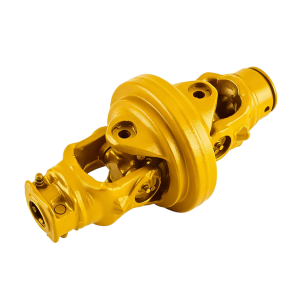
The SD-Double Joint — also referred to as a double universal joint, double Cardan joint, or SD-type PTO coupling — pairs two standard universal joints into a single compact assembly, effectively doubling the permissible operating angle while partially canceling the non-constant-velocity behavior of individual Cardan joints. Available in both whole (assembled) and welded configurations across 11 size classes, the SD-Double Joint is the practical and economical mid-range solution for PTO drivelines that operate at moderate angles where a standard single joint is insufficient but a full wide-angle CV joint is unnecessary.

SD-Double Joint (Whole) Specifications
| Series | Type | A (mm) | B (mm) |
|---|---|---|---|
| 1 | 1.05.DY | 66 | 72 |
| 2 | 2.05.DY | 69 | 78 |
| 3 | 3.05.DY | 79 | 80 |
| 4 | 1310.05.DY | 68.5 | 99 |
| 5 | 100.05.DY | 70 | 109 |
| 6 | 25HP.05.DY | 69 | 78 |
| 7 | 50HP.05.DY | 70 | 109 |
SD-Double Joint (Welded) Specifications
| Series | Type | A (mm) | B (mm) |
|---|---|---|---|
| 1 | 1.05.SDY | 102 | 102 |
| 2 | 2.05.SDY | 102 | 102 |
| 3 | 3.05.SDY | 124 | 102 |
| 4 | 4.05.SDY | 126 | 102 |
| 5 | 5.05.SDY | 134 | 102 |
| 6 | 6.05.SDY | 146 | 102 |
| 7 | 7.05.SDY | 168 | 102 |
| 7N | 7N.05.SDY | 140 | 102 |
| 8 | 8.05.SDY | 168 | 102 |
| 32 | 32.05.SDY | 134 | 102 |
| 36 | 36.05.SDY | 154 | 102 |
| 42 | 42.05.SDY | 190 | 104 |
Advantages of the SD-Double Joint
Handles up to 25° continuous operating angle — roughly double a standard single u-joint — at a fraction of the cost of a CV joint.
Significantly less expensive than wide-angle CV joints while meeting the angular requirements of most agricultural drivelines.
Whole assemblies for ease of installation; welded versions for permanent, vibration-resistant integration into custom drivelines.
From compact Series 1 to heavy-duty Series 42, covering every cross size used in global PTO applications.
The dual-joint configuration partially cancels the non-constant velocity effect, reducing vibration compared to a single u-joint at the same angle.
Both joints are integrated into a single housing that takes less driveline space than two separate u-joint assemblies.
Operating Principle
The SD-Double Joint consists of two standard cross-and-bearing universal joints connected by a short intermediate shaft within a compact housing. When the input shaft rotates at an angle to the output, each joint accommodates approximately half the total deflection. Because the angular error introduced by the first joint is partially corrected by the second joint (mounted 90° offset), the output shaft speed variation is significantly reduced compared to a single joint at the same total angle. This principle — called partial velocity cancellation — makes the double joint a practical middle ground between single Cardan joints and true constant-velocity wide-angle joints.
Where to Use SD-Double Joints
Mowers, tedders, and rakes that sit to one side of the tractor create moderate angular misalignment ideally suited to a double joint.
Belly-mounted mowers and blowers with slightly angled PTO connections benefit from the double joint’s extended angle range.
When the implement height varies as the three-point hitch moves, a double joint compensates for the changing angle smoothly.
Comparison: SD-Double Joint vs. Wide Angle Joint
| Feature | SD-Double Joint | Wide Angle Joint |
|---|---|---|
| Max Operating Angle | ~25° | Up to 80° |
| Velocity Output | Partially constant | True constant velocity |
| Cost | Lower | Higher |
| Best For | Moderate-angle drivelines | Extreme-angle / CV-critical |
Installation Guide
- Select the correct series and type (whole or welded) based on your cross size and driveline requirements.
- For whole assemblies: connect the yoke ends to the PTO shaft and implement input using push pins.
- For welded versions: weld the yoke tube to the implement’s driveline shaft in the correct angular alignment.
- Grease all cross journals before first use and every 8 operating hours thereafter.
- Verify that the operating angle does not exceed 25° under normal conditions.
Important: Ensure the two yoke planes are phased correctly (90° offset) for proper velocity cancellation. Incorrect phasing increases vibration.
Selection Tips
Match the cross size of the SD-Double Joint to your existing PTO shaft series. Choose whole for easy drop-in replacement or welded for permanent installations. If your maximum operating angle exceeds 25°, upgrade to a wide-angle joint. For angles under 12°, a standard single u-joint is more compact and economical. Our product specialists can help determine the optimal joint type for your application.
Quality & Warranty
ISO 9001:2015 certified production. CE marked. Cross journals heat-treated, bearings sealed and greased for life. All assemblies dimensionally inspected and run-tested. 12-month warranty with global parts availability.
FAQ
What is the difference between “whole” and “welded”?
“Whole” is a fully assembled, bolt-together joint for easy installation and replacement. “Welded” has the intermediate shaft permanently welded for maximum rigidity and is intended for OEM or permanent custom driveline builds.
Can I replace just one cross in a double joint?
Yes, individual cross kits are available. When replacing, always check both crosses — if one has worn, the other is likely approaching its service limit as well.
Is phasing important?
Critical. The two yoke planes must be offset by exactly 90° for proper velocity cancellation. Incorrect phasing doubles vibration instead of reducing it.
How does the SD-Double Joint compare in price to a wide-angle joint?
Generally 40–60 % less expensive, making it the preferred choice when the operating angle stays within 25°.
Which series numbers correspond to which PTO shaft size?
Series 1–3 are light-duty, Series 4–6 medium-duty, Series 7–8 and 32–42 are heavy-duty. Cross dimensions in the “Type” column directly match standard PTO shaft cross sizes.
Global Customer Feedback
“The welded 6.05.SDY on our offset slasher handles the angle perfectly. Solid construction and smooth operation.”
“Cost-effective alternative to a full CV joint for our tedder. The 3.05.DY whole joint was plug-and-play.”
“Running the 42.05.SDY on a heavy-duty snow blower. Handles the mid-mount angle like a champ.”
“Perfect for our three-point-hitch sprayer. As the linkage lifts, the double joint compensates smoothly.”
“Great value for our vineyard mower setup. Half the price of a CV joint and more than adequate for our 15° operating angle.”
Complete Your PTO System
Explore our full catalog of Қуат қозғалтқышының біліктерінің жинақтары, torque limiters, wide-angle joints, overrunning clutches, yokes, safety shields, cross kits, and adapters. Every component is designed for seamless integration.